
Reduce lock-in. Strengthen control.
Infrastructure managers with aging signaling systems face a difficult choice: continue to carry growing maintenance risk, or commit to another long cycle of closed-system replacement. Open signaling offers a more controlled path forward, based on modular architecture, open interfaces, and step-by-step modernization.
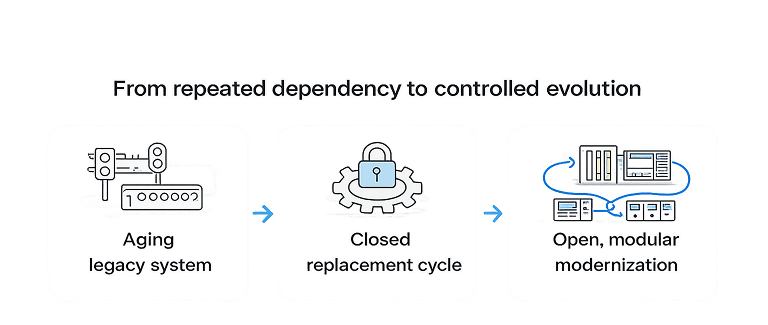
The dilemma infrastructure managers know too well
Many legacy systems remain dependable in daily operation, but the conditions around them are deteriorating. Spare parts become harder to source. Specialist knowledge becomes harder to retain. Maintenance costs rise. At the same time, expectations on capacity, resilience, safety, digitalization, and modernization continue to increase.
A third path: open signaling
Open signaling is not a single product. It is an architectural and lifecycle approach built on modularity, open interfaces, and COTS hardware. It aligns with the positioning of open signaling, digital twins, formal methods, and stepwise migration.
What does this change for infrastructure managers?
Open signaling shifts the position of the infrastructure manager. Instead of accepting that the system has been effectively owned by a single supplier for decades, you gain a stronger role in defining architecture, setting requirements, and shaping how the system can evolve.
What it takes to make open signaling work
Open signaling is realistic, but it is not automatic. It requires technical discipline, architectural choices, and a structured safety and approval process. The value lies in making future change manageable, not effortless.
Start with bounded change,
not network-wide transformation
For most infrastructure managers, the right first move is not to transform the whole signaling landscape at once. It is to begin with a practical step: a pilot, a subsystem migration, an architecture study, an interface strategy, or a well-defined modernization case that proves the method and builds confidence.
Why the Open Signaling Initiative matters
Open signaling will not advance through a single supplier or project alone. It requires infrastructure managers and ecosystem partners to shape shared expectations around openness, modularity, replaceability, and lifecycle control. That is where the open signaling initiative has its role.
Common questions
The shift toward open signaling often starts with strategic questions rather than product questions.