Reduce lock-in. Strengthen control.

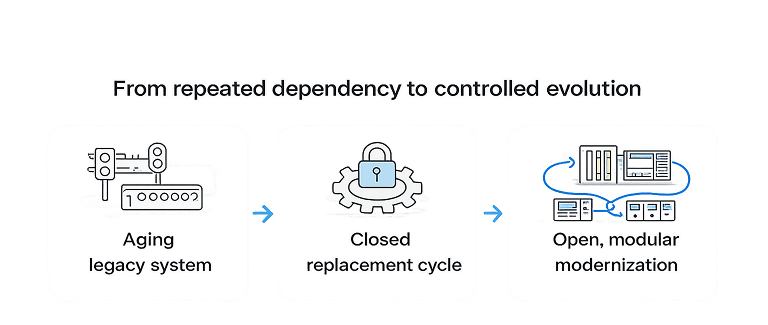
Infrastructure managers with aging signaling systems face a difficult choice: continue to carry growing maintenance risk, or commit to another long cycle of closed-system replacement. Open signaling offers a more controlled path forward, based on modular architecture, open interfaces, and step-by-step modernization.
Open signaling forum

The dilemma infrastructure managers know too well

Many legacy systems remain dependable in daily operation, but the conditions around them are deteriorating. Spare parts become harder to source. Specialist knowledge becomes harder to retain. Maintenance costs rise. At the same time, expectations on capacity, resilience, safety, digitalization, and modernization continue to increase.

Option 1: Continue with the legacy system

In the short term, this can feel like the least disruptive path. But over time, the risks grow: more complex maintenance, fewer experienced engineers, greater reliance on scarce components, and less room to respond to operational or regulatory changes.

Option 2: Replace it with another closed system

This may solve the immediate technology problem, but it often creates a new long-term dependency. Upgrades, modifications, and lifecycle decisions remain tied to a single supplier environment, often through lengthy contracts and limited competitive pressure.

A third path: open signaling

Open signaling is not a single product. It is an architectural and lifecycle approach built on modularity, open interfaces, and COTS hardware. It aligns with the positioning of open signaling, digital twins, formal methods, and stepwise migration.

Open interfaces

Components should communicate through documented, standardized interfaces so they can be integrated and replaced without redesigning the full installation.

Loosely coupled architecture

Signaling logic, hardware, and platform should be separated as far as practical, so one part can evolve without forcing full-system replacement.

COTS-based foundations

Commercial off-the-shelf platforms expand the technology base and improve the conditions for replaceability, resilience, and long-term lifecycle control.

What does this change for infrastructure managers?

Open signaling shifts the position of the infrastructure manager. Instead of accepting that the system has been effectively owned by a single supplier for decades, you gain a stronger role in defining architecture, setting requirements, and shaping how the system can evolve.

More lifecycle control

Changes to the system no longer have to imply full replacement or complete supplier dependency.

Less vendor lock-in

The objective is not zero effort, but bounded effort when components, platforms, or partners need to change.

Better procurement position

A more open architecture creates stronger conditions for competition, comparison, and future flexibility.

Incremental modernization

Networks can move forward step by step rather than relying solely on large, disruptive big-bang programs.

What it takes to make open signaling work

Open signaling is realistic, but it is not automatic. It requires technical discipline, architectural choices, and a structured safety and approval process. The value lies in making future change manageable, not effortless.

01

Use open standards and documented interfaces

If interfaces remain proprietary, replaceability remains theoretical. Openness must be designed in from the start.

02

Separate architecture into manageable components

Hardware, platform, and signaling logic need to be modular enough that one part can be changed without requiring a redesign of the rest.

03

Create a safety approval path for controlled replacement

Safety remains central. The system as a whole must still be shown to be safe, even when components evolve over time.

04

Build around an ecosystem, not a single vendor

Successful open signaling depends on collaboration between infrastructure managers, engineering firms, hardware providers, software partners, safety specialists, and integrators.

Start with bounded change,
not network-wide transformation

For most infrastructure managers, the right first move is not to transform the whole signaling landscape at once. It is to begin with a practical step: a pilot, a subsystem migration, an architecture study, an interface strategy, or a well-defined modernization case that proves the method and builds confidence.

Lower decision risk

Small, bounded initiatives make it easier to evaluate feasibility, safety implications, and delivery models.

Build internal capability

Early projects help strengthen technical understanding, procurement readiness, and organizational confidence.

Create reusable foundations

A first step can establish interfaces, processes, and architectural principles that support broader modernization later.

Why the Open Signaling Initiative matters

Open signaling will not advance through a single supplier or project alone. It requires infrastructure managers and ecosystem partners to shape shared expectations around openness, modularity, replaceability, and lifecycle control. That is where the open signaling initiative has its role.

For infrastructure managers, the initiative offers a place to:

  • Exchange practical experience with peers facing similar lifecycle and modernization challenges
  • Strengthen the market signal for open interfaces and modular signaling architectures
  • Understand what it takes to reduce dependency on closed supplier environments
  • Explore how step-by-step modernization can be structured in practice
  • Help shape the future direction of open signaling across the industry

Why membership matters

When infrastructure managers act individually, the market can continue to default to closed models. When they engage collectively, expectations become clearer. Standards gain traction. Suppliers respond. And the path toward more open, manageable signaling systems becomes more realistic.

Common questions

The shift toward open signaling often starts with strategic questions rather than product questions.

No. One of its core advantages is that it supports step-by-step modernization rather than forcing a single large replacement event.

No. Infrastructure managers will still work with suppliers and specialists. The difference is that dependency becomes more limited, more visible, and easier to manage over time.

No. There will still be engineering, safety, and approval work. The goal is to make that work bounded and manageable, rather than tying every future change to a closed system lifecycle.

No. Open signaling requires an ecosystem. Infrastructure managers play a central role, but success depends on collaboration with engineering firms, hardware suppliers, software partners, assessors, and system integrators.

Because market direction is shaped by those who participate early. Joining helps infrastructure managers influence the conditions, expectations, and practices that will matter in future modernization programs.

Help shape a more open signaling future

Join the Open Signaling Initiative to strengthen your organization’s position, connect with peers and ecosystem partners, and support a signaling future built on modularity, replaceability, and long-term control.

Contact jesper.carlstrom@prover.com to learn more.